Loma Prieta Avenue
By Debra Staab · March 2026 · Volume MMXXVI, Number 3 · Page 20 · 6 min read
Loma Prieta Avenue has served the Summit area for over 150 years. The road is just north of, and parallel to, Summit/ Highland Road. The avenue starts at Summit Road just west of the Summit Store, where it runs slightly north and then makes a sharp right turn. It meanders southeast between straight stretches and hairpin curves for nearly three miles, all the while rising in elevation by over 1,000 feet. Loma Prieta Avenue then intersects Mt. Bache Road and Loma Prieta Way.
If you follow Loma Prieta Way another three miles, you will find Loma Prieta Road, which takes you north to the mountain top. Loma Prieta is the highest peak in the Santa Cruz Mountains, with an elevation of 3,790 feet. If you continue southeast on Loma Prieta Way for another ten miles or so, you eventually arrive in Gilroy.
Mexican Land Grants. When California was under Mexican rule in 1844, a large land grant of nearly 35,000 acres, the Soquel Augmentation, was given to Martina Castro, the daughter of a Spanish soldier. The northern boundary of the grant ran from Laguna del Sargento near Summit West to Mount Loma Prieta on the east. The eastern boundary dropped down from Loma Prieta to Soquel. The short distance from Soquel to Aptos formed the southern border. The line from Aptos back up to Laguna del Sargento established the western boundary. Loma Prieta Avenue sits just below the northern border.
American Pioneers. The southwest came under United States rule in 1848, the Gold Rush started in 1849, and California became a state in 1850. People from all over the world flocked to the area. In 1850, Castro subdivided her land and gave large parcels to each of her eight children. When Santa Clara Valley was filled with property claims, headed to the hills to find land. The Castro holdings became prime real estate, and the family further divided their parcels as more settlers arrived. The area that contained Loma Prieta Avenue was tagged as Tract 24.
Charles McKiernan staked a claim at Summit West in 1851, and John and Susan Schultheis claimed land about two miles east near the Summit and the Old Santa Cruz Highway in 1852. Both lots were free government land meant for homesteading. The Burrell family arrived in 1853 and staked their claim a few miles east of the Schultheis family, near what would become Loma Prieta Avenue.
At the time, Burrell assumed that his land was free for the taking. It wasn’t until seven years later, in 1859, when a new survey of the Soquel Augmentation was completed, that he learned his parcel was already deeded to one of Martina’s daughters, Antonia Lodge Peck. Burrell did not want to lose the home he’d worked so hard to build, so even though it was a hardship, he agreed to pay the Pecks $1,500 for about 1,500 acres.
The Meyer family arrived in the mountains in 1864, the Morrell family came in 1867, and the Wrights moved here in 1868. All three families purchased land from Burrell, and the group soon became known for their excellent vineyards. Meyer further subdivided his land into many small 20- to 30-acre parcels which eventually formed the German Colony.
The Santa Cruz Mountains Flourish. Over the next 30 years, the region grew by leaps and bounds. Settlers came from all over. Many were wealthy bankers, lawyers, doctors, politicians, and professors. Scrub and brush made way for gardens, orchards and vineyards. Large estates, villas, resorts, , and churches were constructed.
In 1880, the South Pacific Coast Railroad connecting San Jose to Santa Cruz roared through the Santa Cruz Mountains for the first time. The railroad towns of Wrights, Laurel, and Glenwood popped up. The fruit and wine industries boomed and logging was on a fast track to prosperity for all involved.
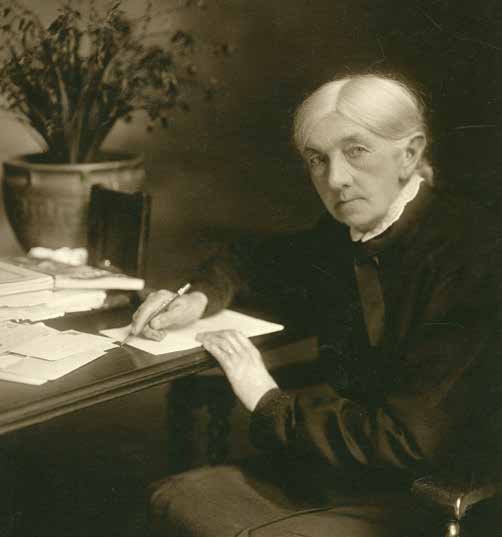
There were now hundreds of people living in the mountains. Loma Prieta Avenue became a showcase neighborhood. Rows of white picket fences lined both sides of the road, which spurred the local nickname “Whitewash Alley.” It became even more distinguished when Burrell sold 26 acres to Josephine Clifford in 1880, for about $500. Clifford was a well- known writer whose articles had been printed in multiple publications.
Having recently escaped an abusive marriage, she savored her new surroundings and described the area like this: “The avenue is lined all the way by cottages, villas, and gardens that make the heart glad at every season of the year.” She called her new home Monte Paraiso (mountain paradise) and went on to say, “Above and beyond this, we boast of a climate and of scenery which will be sought by tourists from all parts of the world, and the spot will become a Mecca to those in search of health.”
The McCrackins. Josephine married Andrew “Jackson” McCrackin in 1882, and they lived happily together at Monte Paraiso. He had made his fortune managing a successful silver mine in Arizona that produced over four million ounces of the metal. He cashed out to the tune of nearly a quarter-million dollars.
Josephine’s career skyrocketed as she penned pieces for the Overland Monthly, the Mountain Echo, the Santa Cruz Sentinel, and the San Jose Mercury Herald (now Mercury News). Her home became a bustle of literary activity. Her many visitors included Ambrose Bierce, Andrew P. Hill, Ina Coolbrith, Bret Harte, Joaquin Miller, Mark Twain, Herman Scheffauer, and Jack London.
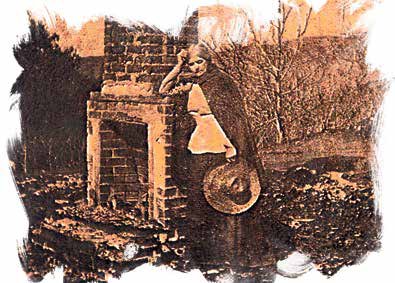
The Great Summit Fire of 1899. On October 8, 1899, a careless settler was burning brush when high winds whipped up Josephine McCracken at Monte Paraiso
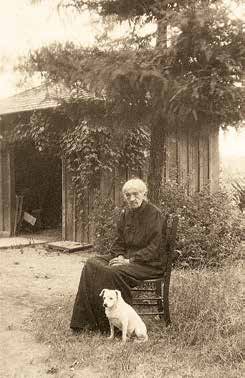
Josephine at the ruins of Monte Paraiso The Sempervirens. After the fire, Josephine was so distraught over the destruction of the beautiful redwood forest that she started a movement. Enlisting help from photographer Andrew P. Hill, John Muir and the Sierra Club, botanists, lawyers, the press, and state politicians, McCrackin set about to create a protected redwood park in the Big Basin area. The land was owned by a lumber baron named Henry L. Middleton. Middleton’s machinery was already in place and ready to clear- cut the area. McCrackin didn’t give up, and in 1901 the state purchased the land for $250,000. The Redwood Park (now Big Basin) was created, and the Coastal Redwoods (Sequoia Sempervirens) became a protected species. McCrackin founded the Sempervirens Club to protect the majestic Jackson McCrackin died in 1904 and is buried at Monte Pariaso, where his grave marker is still visible today. Josephine moved to Santa Cruz where she continued writing and advocating for environmental conservation. She died in 1920 and is buried Loma Prieta Avenue Today. By the late 1930s, the lumber barons had felled all of the trees they could reach, and the lumber industry basically dried up. This caused the rail-freight industry to also collapse. With light passenger ridership and frequent storm damage, the South Pacific Coast Railroad abandoned its mountain route in 1940. The same year, Highway 17 opened and cars and trucks took over where the trains left off.
Although life on the avenue lost some of its bustle after the demise of the railroad and subsequent decline of Wright’s Station, the natural beauty remained. We still have the bucolic scenery, fresh air, and quaint cottages continue to With its historical roots, Loma out of nowhere. The fire instantly grew and spread across the mountain. Up on Loma Prieta, most of the German Colony was destroyed. Lower down near the Summit, the estates of Mrs. Josephine Clifford McCrackin, Dr. Edmund Goldmann, and Mr. Emil Meyer were all caught in the flames. The fire roared and smoke was too himself leaped to the rescue and broke the gas pipe connected to their only source of water. In a split second, Meyer directed the crew to attach their hoses to his wine vats. It took the team all night using 4,000 gallons of claret to finally douse the inferno. Some of the crew did not survive. Down river, locals reported that Los