Land Grants Near the
Santa Cruz Mountains
By Debra Staab · March 2025 · Volume MMXXV, Number 3 · Page 20 · 9 min read
The Spanish Empire was well on its way to becoming a superpower in 1469, when Catholic monarchs Isabella I and Ferdinand II married. The couple sought to expand their combined kingdoms’ wealth by exploring new territories, creating new trade routes over land and sea, trading new and exotic goods, and spreading the word of God via Catholicism. In 1492, they commissioned the journey of Christopher Columbus, who sailed across the Atlantic to claim the Caribbean Islands. By 1521, Cortez had defeated the Aztec Empire and claimed Mexico. Spanish expeditions to Alta California included Cortez in 1535, Cabrillo in 1542, Drake in 1579, and Vizcaino in 1602. The Age of Discovery continued through the 16th and 17th centuries as Spain colonized areas around the world at its peak (see map).
During the era of colonization, the Doctrine of Discovery permitted explorers to confiscate any lands that were not already Christian. The Portola crusade in 1769 established the first missions at San Diego, and soon after at Monterey. Between 1769 and 1804, 21 missions were built.
Indigenous peoples were either converted to Christianity and moved into the missions, enlisted as guides, chased away, or killed. Many died from diseases brought by the settlers. In 1776 the Anza expedition brought colonists to our area, and the Spanish crown granted land to establish communities. The Pueblo of San Jose was founded in 1777, the Pueblo of Los Angeles in 1781, and Villa de Branciforte was settled near Santa Cruz in 1797.
The Spanish were very protective of their territorial conquests, and they established presidios (military bases) at San Diego, Santa Barbara, Monterey, and San Francisco. They limited foreign trade and prepared to defend their property from the French, English, and Russians who were also claiming land across the Americas. By 1784, a small number of private land grants were given to individuals to encourage farming and industry or as rewards for military service. The grants were restricted in size to a maximum of three square Spanish leagues (about 13,285 acres), and the recipient agreed to build a storehouse and stock a minimum of 2,000 head of cattle. During the entire Spanish governance era, only 30 private land grants were issued across California.
In the South Bay area, only four were given: Las Pulgas in San Mateo, Las Animas near Gilroy, Los Tularcitos near Milpitas, and San Ysidro near Gilroy. In 1808, Spain descended into chaos when Napoleon invaded, toppled their monarchy, and installed his brother Joseph as the new leader. The occupation triggered a local revolt known as the Peninsular Wars which lasted for five years. Combined ally forces finally expelled the French in 1813, and Bonaparte abdicated the French throne in 1814. Even though the Spanish monarchy was restored, the upheaval rippled across the seas to cause unrest in the various Spanish colonies. That included New Spain, especially Mexico, and between 1810 and 1821 insurgents fought royal forces in the Mexican War of Independence. After 11 years of fighting, the opposing parties were at a stalemate until a prominent Spanish commander deserted and joined forces with the insurrectionists.
The combined forces quickly dismantled the Spanish rulers, and in September 1821 they signed the Treaty of Cordoba which ended Spanish rule. The federal republic of Mexico was codified in 1824 and officially recognized by Spain (under Isabella II) in 1836.
Mexican rule over California started in 1822 as royal Spanish flags were replaced by the new eagle and snake flag of the Mexican republic. In 1824, Mexico codified new rules for land grants. All grants were to be between one and 11 leagues (from about 4,500 to 48,712 acres), of which at least one league was to have irrigable soil, four that depended on rain, and six that could be used for grazing. The recipient was required to build a house, stock the land with cattle, and plant trees along the borders. Any citizen could petition for a grant by submitting a form and a rough map of the desired property. A land survey was conducted for each request, including measurements and witnesses for validation. Approved grants were documented and archived by the government.
The most significant change in strategy between the Spanish and Mexican governments revolved around the mission system. The original plan under the Spanish crown was to use the missions as temporary facilities to Christianize and acculturate the Native peoples. Once that was accomplished, the mission lands were to be returned to the local tribes. Clergy would replace the missionaries to carry on the Catholic crusade.
This was called secularization. Under the new Mexican constitution, all citizens were considered equal regardless of race. Because the mission concept denied basic freedoms to the Native Americans, the entire mission system was ruled unconstitutional. In 1834, the governor of California ordered complete secularization of all missions. Although the proclamation stated that the land was to be distributed to native tribes, many locally born Spanish cheered the new rules because they hoped to farm the religious parcels and use Native Americans as cheap labor.
Over the next several years, all 21 missions were secularized by largely unsupervised government administrators. Unfortunately, they sold off the livestock, grain, and lands to prominent families rather than return the property to the indigenous tribes. Mission Santa Clara was converted to a college and survived destruction. In the end, only a handful of land grants were directly issued to Native Americans. In the South Bay region, the following grants were given to former “Mission Indians”: La Purisima Concepcion (Los Altos Hills), Posolmi (Mountain View, Sunnyvale), Los Coches (San Jose), and Ulistac (Santa Clara).
Most of the mission land and other open space was given to wealthy Mexicans. Some received multiple large grants. These rancheros primarily raised cattle, along with hay and grain as feed. From 20 to several hundred Native Americans were enlisted to work on the ranch, typically earning no more than room and board. Researchers estimate that there were about 4,000 “Mission Indians” used as the ranchero workforce.
Around Pueblo San José, there were a few ranches that hosted large numbers of Native Americans, including Rincon de los Esteros Map of the Spanish Empire in 1790
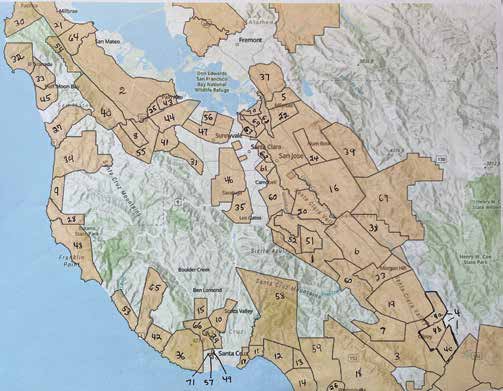
(Alviso), Quito (Cupertino, Saratoga), Santa Teresa (Santa Teresa section of San Jose), and Pala (San Jose). A few groups of “Free Indians” also settled near San Jose. A number of grants were issued in the Santa Cruz Mountains. In the spring of 1833, Rafael Castro was granted about 6,700 acres at Aptos. He was the son of Joaquin Castro, an early resident of San Jose, and descendent of the Spanish Castile line. Later the same year, Martina Maria Castro, sister of Rafael, was awarded about 1,700 acres of land at Soquel. Over the years, it seems that Rafael’s cattle drifted onto Martina’s property to the point where she didn’t have enough grazing land left for her own herd.
She petitioned for more land, and in 1844 received a large parcel of about 33,000 acres called the Soquel Augmentation (also called Shoquel to distinguish it from the small The first settlement at Los Gatos developed from a 6,600 acre grant called Rinconada de Los Gatos. A grant of about 4,400 acres at San Augustine became Scotts Valley, and a grant called Zayanta left behind roads called East Zayante, Zayante Drive, and Upper Zayante, as well as Zayante Creek.
By the 1840s, Americans started to arrive in California via overland trails. They had heard about the mild climate, abundance of natural resources, and generous land grants. In 1846, the United States declared war on Mexico, believing that it was manifest destiny to expand their territory. After the United States took over Mexico City, Mexico agreed to peace talks. In 1848 the Treaty of Guadalupe Hidalgo was signed to end the war. As part of the agreement, the United States paid Mexico $15 million to purchase California and all Mexican territory north of the Baja Peninsula. The treaty also guaranteed that the property rights of all existing grantees would remain intact.
In spite of the treaty’s promise to honor all land grants, the California Land Act of 1851 required all property holders to provide proof of ownership. This was a difficult and arduous task for many, as the original deeds were from another country and in Spanish.
Records show that 813 claims were filed and only 604 approved. Almost all went through the courts before they were settled, and some cases dragged on until the 1940s. Native Americans in California faced the most difficult challenges to reclaiming property under U.S. rule. California state laws ignored the Treaty of Guadalupe Hidalgo and denied Native Americans’
citizenship, voting rights, and the right to testify in court, and allowed them to be used as indentured servants. Between 1849 and 1852, the U.S. government attempted to extinguish all Native American land titles through treaties that would give the tribes reservations or allotments if they relinquished all land claims. Nearly 7.5 million acres of land were to be given to the tribes. Regrettably, the court of public opinion quickly squashed the plan. It was canceled under an injunction of secrecy that In 1854, there was another attempt to move Native Americans to reservations. Once again bureaucratic corruption ruined the plan. Most of these parcels were abandoned in the 1860s, having helped less than 3,000 out of about 70,000 surviving Native Americans. The Bureau of Indian Affairs (BIA) in Washington did little to help.
In 1869, President Grant initiated a peace policy which declared that the only way to solve the “Indian problem” was to Christianize them and allow private- property ownership on larger reservations. The program was implemented in California starting in 1893 and saw the creation of some 2,300 allotments. The policy soon met with significant opposition from tribal leaders. Failure of the BIA to process the claims brought the program to a screeching halt. The law was repealed in 1934.
Once again, between 1952 and 1972, the US BIA attempted to relocate Native Americans, this time to cities. The goal was to erase all Indian culture, eliminate the BIA and tribal governments, and reclaim reservation land. These goals were to be accomplished by moving families to large cities where they could assimilate into white communities. About 100,000 Natives accepted the one-way tickets. The campaign failed to eliminate the tribes, but about two- thirds of the Native-American population still live in cities rather than on reservations.
Centuries after Native people were displaced, reparations for their mistreatment are finally being discussed. In 1978, California created the Native American Heritage Commission to liaise with state, federal, and tribal governments. For the first time, a Native American was appointed as Secretary of the U.S. Interior in 2020.
Over four years, Secretary Haaland made significant progress to help Native peoples. By 2024, over 38,000 acres of California native lands have been turned over to tribal stewardship. Governor Newsom summarized the intention of the reparation plan saying, “These awards are an acknowledgment of past sins, a promise of accountability, and a commitment to a better future—for the land and all its people, especially its original stewards. Only through partnership with California Native American tribes can we address the climate and biodiversity crisis and build a healthier California.”
Land grants in the Santa Cruz Mountains