Lago Lomita Vineyards
Vineyards as Firebreaks
By Robin Porter · February 2025 · Volume MMXXV, Number 2 · Page 6 · 4 min read
Our story is usually about our vineyard operations. With the advent of the terrible fires in Southern California (and others in California), it’s time to talk about one reason vineyards are important to our mountains. A review of the Sonoma fire showed some surprising findings. While structures, including wineries, were burned to the ground, the surrounding vineyards remained intact. There was smoke on the grapes, making that year’s harvest mostly unusable, but the land and the vineyards were in good shape. Why? First, vineyards are green plant material. Even in winter, or dormant months, the vine is very much alive. A living plant has water content and is harder to burn than old, dry weeds and brush.
The vineyard rows are routinely cleared of brush because you want to give the vines as much soil and water resources as possible. All the rows are irrigated with drip systems, keeping acres of land hydrated. To allow room for the tractor to go up and down the rows and turn around at the end, most vineyards have service roads surrounding them, making them easier to defend. This creates a natural firebreak. Accessibility is key in a large fire.
Finally, there are water storage tanks with hydrants, holding a large supply of readily accessible water with a fire-hydrant fitting. One of the projects CalFire has been evaluating in our mountains is to link the many vineyards along the ridge—much like a string of pearls—with a firebreak. This would join wineries such as Loma Prieta, Lago Lomita, and others all the way across the ridge forming a massive, and more effective, firebreak. It would help protect the land from the ridge down towards Santa Cruz. This project was funded for a while but was interrupted by the CZU fire.
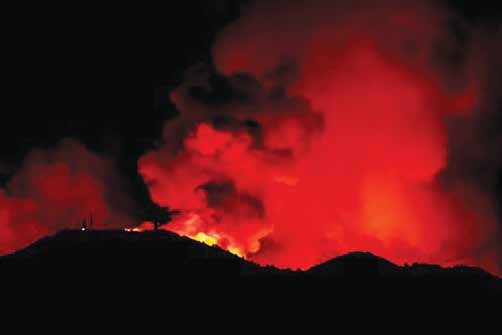
It would be worthwhile for us to ask our county supervisors the status on renewing this work. 2016 Loma fire photographed from Lago Lomita Vineyards Lyme Disease in Dogs Fahimeh Zibaee, DVM Winter and early spring are a time of high tick activity in our coastal hills. The western black-legged tick is the primary vector of Lyme disease and other tick-borne illnesses in our area. According to the Santa Cruz County Mosquito and Vector Control Division, at least two percent of ticks tested locally in recent years has tested positive for Borrelia burgdorferi, the bacteria that can cause Lyme disease.
Lyme disease is transmitted to humans and animals through the bite of infected ticks. There is far less Lyme discase on the west coast compared to the east, but the northern coast of California is considered to have moderate risk.
Most dogs infected with Borrelia bacteria will appear healthy. Only about five percent will experience symptoms. Among people infected, about 90 percent will become ill with a rash and flu-like symptoms. A few weeks later, they may develop joint pain and neurologic abnormalities.
In dogs that do become ill, signs of Lyme disease typically show up two to five months after the dog’s infection. By this time, the disease can be widespread throughout the body. The most common signs are intermittent limping or lameness that shifts from leg to leg, fever, loss of appetite, decreased activity, swollen lymph nodes, and painful, swollen joints. Between one and five percent of infected dogs may develop a type of kidney disease called Lyme nephritis, which can lead to edema, weight loss, vomiting, diarrhea, and sometimes death.
Because other diseases can mimic Lyme disease, and most dogs with Borrelia infections do not become ill, diagnosing Lyme disease can be tricky. Your veterinarian will consider a dog’s history of tick exposure, clinical signs, and laboratory test results.
The standard treatment for dogs sick with Lyme disease is a 30-day course of antibiotics. A longer course may be necessary for some dogs. Antibiotic therapy generally is not recommended for dogs without signs of illness, nor is it recommended to prevent Lyme disease in dogs with tick bites. Dogs with Lyme nephritis require additional treatments to manage problems associated with kidney impairment.
The best way to protect dogs against Lyme disease is to take preventive measures to reduce the chance of tick bites. Use reliable tick-preventive products as recommended by your veterinarian. When possible, avoid tick-prone spots like tall grasses, marshes, and wooded areas. If hiking on trails with your dog, stick to cleared trails and avoid brushing against overhanging branches or shrubs.
Perform daily “tick checks” on all pets and people in your home during high- risk seasons, and carefully remove any ticks found. Make your yard unfriendly to ticks by mowing grasses, trimming bushes, and removing brush. Ask your veterinarian whether your dog could benefit from vaccination against Lyme disease.
The vaccine isn’t right for every dog. Your veterinarian will consider several factors in making a recommendation, such as the risk of Lyme disease in your area, your pet’s lifestyle and overall health, and any travel plans you have with your dog.